

Regular readers will know that in recent years my travels have turned towards Europe and sustanability, namely using rail as my main form of transport. So perhaps it’s not that surprising to find myself in the Dutch city of Utrecht. Because this is the home of Eurail, the company that sells rail passes to people around the world.
I’d love to tell you more about the operation, I really would. But I’m here by invitation to take part in some market research for the company. And as we’re discussing conmercially sensitive topics I really cant say anything more. However, by absolute transparency, Eurail has given me a seven day pass as a reward for taking part.
Utrecht is my starting point and it’s something of a whistle stop. After a hard day discussing all things railways, I have just a few hours of a morning to see the main sights. Dominating the old town is the Dom Kirk– the Cathedral of St Martin. Even if you’re not facing in the right direction, you’ll likely hear it before you see it, thanks to the regular chimes coming from its massive bell tower.


Both structures are so vast they can only be appreciated with a wide angle lens. The Cathedral is the dead centre of Utrecht – and also marks the spot where the Romans first settled in the first century. The Netherlands was part of the Limes, the most northern reach of the Empire – and under the square is a whole museum showing Roman remains. However, it’s too early in the day to get access.
A cold late October morning is a god time to grab a coffee, and the Oudegacht – or old canal – is the perfect place to sip it or pose for a picture.

Bicycles are everywhere in the Netherlands, and many of the Low Countries. They appear to outnumber any other form of transport, and usually take priority over every other vehicle on the road – inlcuding pedestrians.
Cities like Utrecht are easily walkable, so it’s good to look – and look again – before crossing any roadway or pavement. Although at one particular crossing you won’t be looking for the green man, but the green bunny.

Miffy – the playful cartoon rabbit – was invented by Utrecht local Dick Bruna in 1955 as a way of entertaining his young son. 75 years later, Miffy is still going strong; there’s a museum dedicate to her here, and even a traffic light. (Though getting a picture of the light itself can be perilous – not least because of the aforementioned bicycles).
On an unassuming side street near the cathedral is the impressive Huis Zoundenbalch. It was built in 1467 by Evard Zoudenbalch – the then Canon of the cathedral. His palatial home was largely destroyed by a fire in 1903, but the facade was recreated – and the building today houses apartments.

By this evening, I need to be in Belgium, so it’s a hasty retreat from the Netherlands. However, when many trains stop at a small town en route, it would be rude not hop off. Thanks to my rail pass, this is entirely possible.
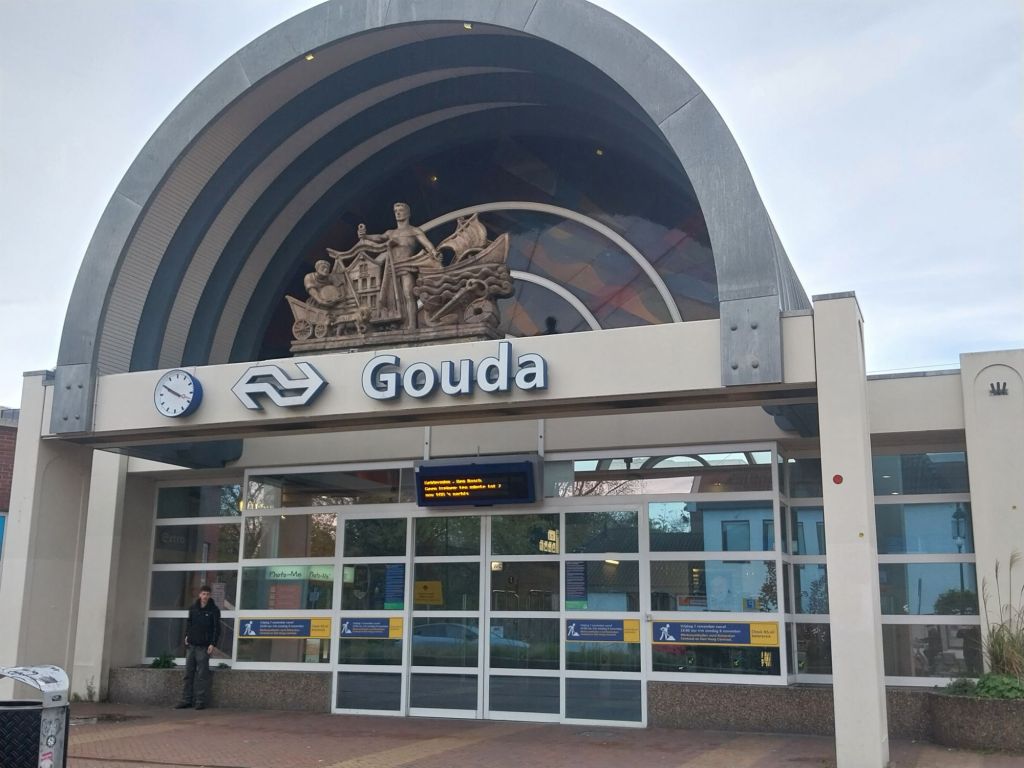
Gouda may not have quite as much historic charm as Utrecht, but it’s known all over the world for its most famous export. Cheese has been made here for centuries, and you can learn the story thanks to the Gouda Cheese Experience.
“Our website is VERY strict but we’re not so bad in real life,” says the helpful host on reception, You can only buy tickets online and it’s compulsory to select a time slot for your own cheese experience. But once here (and off season) it’s easy to just go around the attraction at whatever time you arrive.

What follows is a playful, interactive self guided audio tour, walking you through how cheese is made and how much pride they have in the Gouda product. It’s one of the better museums I’ve visited – and while the whimsical commentary is great for families, it’s also fun for adults. There’s a mandatory quiz, which thankfully ends in a tasting of five types of cheese. Your host will determine whether you have earned the title of Cheese Master – or just clogging the place up.


Most visitors will linger longer in and around Utrecht. But the compact nature of this part of the world makes it easy to cover a lot of ground in a vey short space of time.
TravelCaster Tips
Getting here : The Netherlands is well served by flights from around the world to Amsterdam Schipol airport. But from the UK, you can also take a Eurostar service to the Dutch city. To get to Utrecht, alight the Eurostar at Rotterdam, where intercity trains connect every 20 minutes during the day.
Orientation : Utrecht Centraal station is a vast complex, but just follow the signs for the Centrum and you’ll be in the old town in a 15 minute walk. There are several chain hotels based around the railway station and the heart of the city is extremely walkable.
Public Transport : If you’re planning to travel beyond the centre of Utrecht, there’s a wide range of buses and trams. The UOV website has all the details though the planner can be difficult to navigate. The state run Netherlands Railway has an extensive network across the country and beyond. Distances and journeys are relatively short and trains are generall on time.
Food and drink : Prices in Utrecht are comparable with other parts of Northern Europe, though less expensive than Amsterdam. A decent main course in a restaurant will cost between €15 and €30. However, the Netherlands is fanous for its street food and snacking culture. Waffles, fries and other quick bites are available everywhere. A standard beer will cost between €3 and €6 – many bars also serve Dutch or Belgian craft beers which can be more expesive – though they are also stronger, so you should choose a small measure of 15cl or 25cl.
 TravelCaster
Leave a comment