
It was always going to be an early start; a day trip from Dubrovnik to Bosnia-Herzegovina. So the plan was to have an early night. But some of the best parts of travel come when the unexpected happens. And on the stroke of 9pm, I heard the sound of singing from my apartment, accompanies by guitars and an accordion, The early night was abandoned in favour of a night of Balkan pop.

The picture doesn’t do it justice. But Bar Betula was so rammed that the four piece band simply performed in the middle of the small room. The audience – as I’ve come to realise over the past few nights – is forced to watch from the steps outside.
Any hope of sleeping is out of the window, or to be more precise, literally outside my own window. Thankfully the live music stops at 11pm, but that doesnt stop the customers continuing long into the night. It’s Halloween – but more importantly, tomorrow is All Soul’s Day, a national holiday across the Balkans, so nobody’s got to get up for work.
None of my fellow passengers awaiting rthe coach at the Pile Gate look escpecially gleeful at theor own 6.30am start; but this is a 12 hour day trip which will take us over a national border to two of the most memorable sights in the region,
The complicated history of the Balkans mean a quite in geography that has only recently been resolved. The Dubrovnik region sits separate from the rest of Croatia because of the City of Neum. It’s owned by Bosnia-Herzegovina, and is the country’s only access to the Adriatic Sea. As a result, Croatians were forced to go through Bosnia-Herzegovina – though for many years this was just a formality.
But no more. With Croatia joining the European Union, that meant much stricter border checks. The solution was the Peljescac Bridge – a €423 million project spanning 2.3 kilometres to the south of Neum. We get a view of it during out first coffee break of the day.

The border check takes about 20 minures, which isn’t bad going since there are about 30 passengers on the trip from all over the world. Our onboard guide, Carolina, is extremely knowledgeable about all aspects of the area’s history, her commentary making light work of the three hour journey.
Once inside BH (as it will be called from now on), the landscape dramatically changes, We leave the Adriatic coastline behind to climb into mountain country, The road signs are now bilingual – using the Latin and Cyrillic alphabets. The latter is a hangover from the days of Yugoslav rule, which understandably pisses off the locals. Many of the Cyrillic signs are blanked out by black spray paint, while various towns and villages have defiant political slogans from both sides of a bitter conflict.
It’s the war of the 1990s that has brought us here today. In 1995, the city of Mostar became famous worldwide when, after months of fighting, its iconic Ottoman bridge – used as a military supply line for the Bosnians – was shelled and destroyed by the Croat army. It was eventually reconstructed using the same building methods as the original, and reopened in 2004.

You can make your own way to Mostar by hiring a car. There’s also a rail service from the BH capital Sarajevo, though at the time of writing (Autumn 2004) it’s been closed by a landslide caused by devastating floods. Nobody knows when or if it will ever reopen.
The advantage of coming on an organised tour is the history you’ll learn. As we pull up into the busy coach park in Mostar, Carolina is replaced by Edin, a young Bosnian man who knows fare more than his age suggests.

As well as Edins, you’re just as likely to encounter an Amir or a Muhammad in Mostar. This region was characterised by its Ottoman past, with Muslims forming a sizaeble part of the population. And as today is Friday, the traditional call to prayer – the Muezzen – sounds from the various mosques in the Old Town.
But it all seems a bit strange. You may have thought that Mostar would be a deeply moving place – which it is – surrounded by reverence to its terrible recent history. There are museums, and when Edin was telling us about the city’s past, there was a respectful air of silence. But Mostar Old Town is essentially one long tourist strip – tacky souvenir shops and restaurants staffed by people in traditional costumes.

It all seems a bit wrong. On the other hand, Bosnia is still a relatively poor country compared with places like Croatia. And if the tourists come by their millions every year, there’s obvious money to be made. As a visitor, there is a plus side; food and drink prices here are considerably cheaper than in Dubrovnik – a beer costs around €2 while a main lunch or dinner course can be found for less than €10 – and those prices are within Mostar’s Old Town. Venture outside the city walls and you’ll get even better value.
A word on money in BH
While this blog prices things in Euros, Bosnia-Herzegovina has its own currency – the Convertable Mark. This means if you use an ATM in BH, you’ll only get Marks. The good news is that most tourist shops and restaurants accept Euros too – it’s roughly 2 Marks to the Euro. The bad news is that many insist that you pay in cash, so if you usually reply on your credit card when travelling, make sure you bring cash for these trips. And always ask for your change in Euros – if you don’t you’ll likely end up wth a pocket full of Marks. And one final note, Bosnia-Herzgovina charges a Tourist Tax of €2 per person, which you’ll usually have to pay to your tour guide.

On this trip, Edin’s Old Town tour is done within 30 minutes, leaving about two hours of free time to explore. It’s more than enough to see the main sites before we head to our second destination of the day.
The Kravica Falls flow from a height to 28 metres, spanning 120 metres wide. It’s no Niagra but it’s still an impressive and beautiful sight. We’ve come right at the end of the season, with only around 100 people here today. But with 2,300 hours of sunshine a year, this place can get rammed. Alongwith day trippers there’s a motor home campsite, complete with its own mini supermarket.
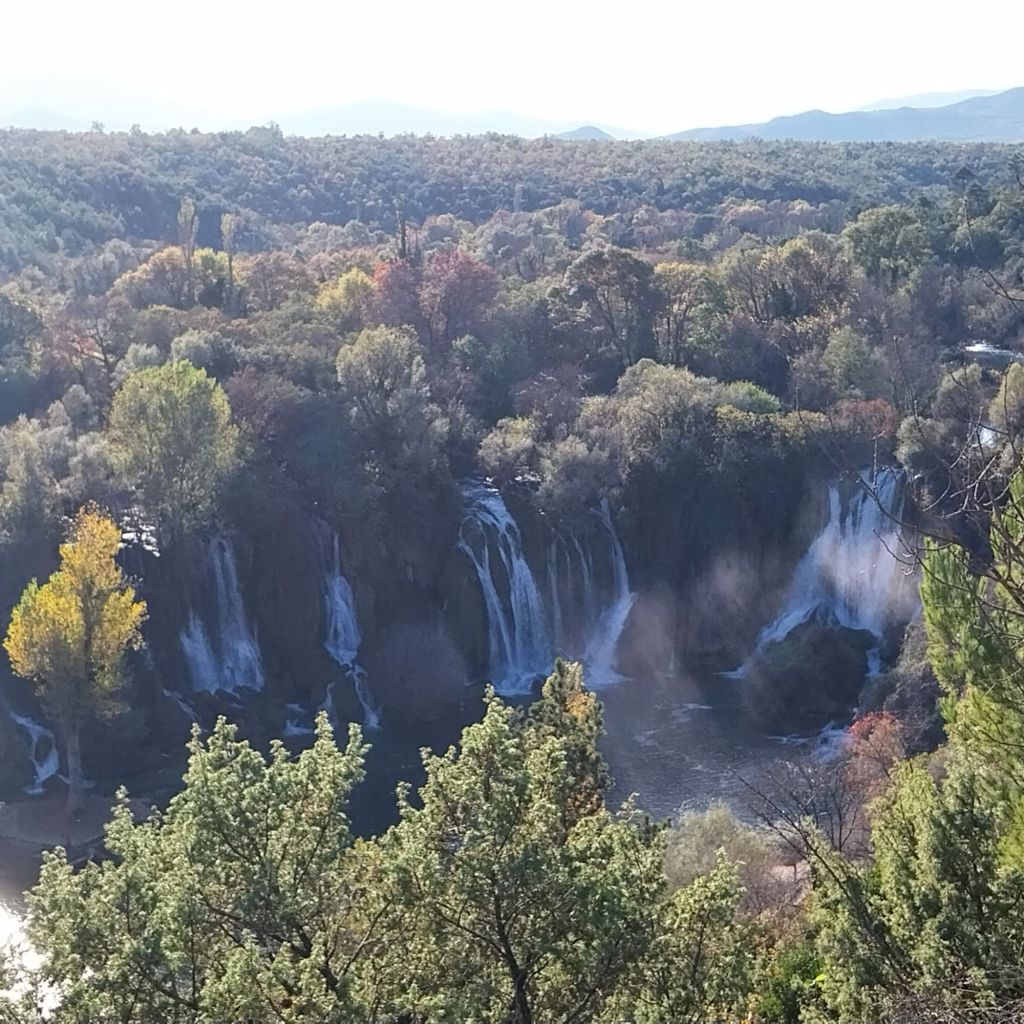

Today its a far more tranquil vibe. A handful of hardy souls take a swim in the crystal clear – but freezing cold – water. The size of the coach park makes me thankful to have come at an off peak time.
It’s a two and a half hour ride back to Dubrovnik – and our coach driver decides to take a scenic detour around Lake Svitavsko – part of a National Park – and into the mountains. Pictures may have been possible had it not been for my fingers nervously gripping the seat as we climb ever higher, taking perilous hairpin bends on single track roads which are clearly not made for large vehicles, like coaches. The driver smiles as he Sam’s the brakes on to let cars past; this clearly isn’t his first rodeo.
We’re back at the Pile Gte fm 6.30pm – 12 hours from the earliest of starts. My body tells me I need the early night I’d planned last night. My mind leads me to a karaoke bar in the Old Town and bed at 2am – content with a day of memories and a night adding a new tune to my repertoire.
How to do it
There are three main day tours from Dubrovnik – to Mostar and the Kravice Falls, across the southern border to Montenegro, or to the Croatian wine region and island of Korcula. You’ll find all of these listed on various websites, but my advice is to wait until you’re in Dubrovnik and choose from there – you may want to change your plans if the weeather’s bad, for example. You’ll also avoid paying het commission fees.
The main tourism centre inside the Old Town by the Pile Gate will sell you tickets, as will a couple of travel agencies just off the Stradun. All appear to have roughly the same price structure; the day trip to Mostar described here cost €65 at 2024 prices,
As mentioned, Bosnia-Herzegovina has its own currency, while Montenegro uses the Euro. Don’t assume that credit cards will be accepted, especially if you’re visiting smaller towns on villages. On any trip involving a border crossing you’ll need to take your passport. Most border checks involve the tour guide collecting your passport and returning it once the border is crossed.
If you’re planning to travel independently, you can get a regular coach to various locations from Dubrovnik. An example is Arriva, which runs a service from Dubrovnik at 8.30am – taking about 3.5 hours – for €23.50. If you have the time to plan, visit the main bus station in Gruz a day or two before travelling to check out othe deals,
It is possible to hire a car and drive just about wherever you like. But an organised tour is likely to be easier, and safer overall. You’ll be able to leave any heavy bags in the bus while visiting paces, and bring your own snacks. Also ensure you bring plenty of water, as you’ll likely be walking a lot during the day.
 TravelCaster
Leave a comment