

The sun is finally shining again as I preapre to leave Villach, and today’s journey should be relatively stress free as the train to Stuttgart is a direct connection. Despite technically bing an international service – operating in Austria and Germany – seat reservations aren’t mandatory. I’ve booked one anyway, as this is a Euro Cities train, running some of the railway’s older rolling stock, which means the First Class coaches have compartments. It’s going to take almost seven hours, so I want to be sure of getting a decent seat and a place to relax..
Confusingly, it looks as if every seat is reserved this morning, so I duly male my way to the allocated seat, only to be joined by a man who casually decides to watch football highlights on his mobile phone. This being 2023, of course, he doesn’t bother using headphones. t’s one of the more annoying aspects of modern rail travel, and the practice doesn’t seem to be reserved for younger people.
It turns out that the signs on the doors actually mean that the seats aren’t reserved after all, so I make my way to another compartment and enjoy the views. and if you’re travelling in this part of Austria, you’re in for a treat.

The photo doesn’t do it justice, but the next hour is a joy as the train snakes its way through the Southern Tyrol towards Salzburg. At times, the curvature of the track means you can see the front of the train from the window. At Salzburg, close to the German border, a quirk of the German railway booking system. So although none of the seats were reserved when I started in Villach, they can be booked while the train is moving.
My peace is destroyed by two couples – one elderly and one slightly younger – the second pair insist that the window seats are theirs, with no negotiation or reason. I’m forced to sit in the worst possible place – a middle seat between the two couples, Nobody speaks. For hours. I take cover in the restaurant car for a while, where at least there is conversation as people order their food and drink.
36 Hours in Stuttgart
It’s a warm evening when we finally get in to Stuttgart around 20 minutes late. I usually enjoy taking a photo of the front of a railway station on arrivals, but here it’s impossible. A huge construction project is underway at the front of the building, as passengers are forced through a horrible temporary tunnel. The welcome is made worse by the inevitable collection of rough sleepers and drunks on the streets surrounding the station. This is becoming commonplace in much of Europe, but neither the railway authorities or the police seem to be bothered. In fairness, there is rarely violence – at least not towards passengers.
After checking in to the hotel, I head towards the City Hall, The Rathaus is often accompanies by a pretty square and outdoor dining. But Stuttgart – another place heavily bombed in the Second World War – doesn’t do tradition. The whole place is surrounded by geometric concrete buildings, and the Rathaus itself reeks of functionality over style.

It takes me some time to find my bearings. The hotel room card has a tourist map, proclaiming that the Bohnenviertel – the Od Town – is well known for its wine taverns and pub. Perhaps it was a Sunday afternoon thing, but the only signs I could see were for closed up strip bars. Even Paddy’s Pub – a ubiquitous Irish bar – is closed for the day.
The problem was that I’d take a U-Bahn train directly to the Rathaus. Had I walked from the hotel I would have come across the Schlossplatz – one of Stuttgart’s landmark squares, which looked a lot better than the surrounding area.
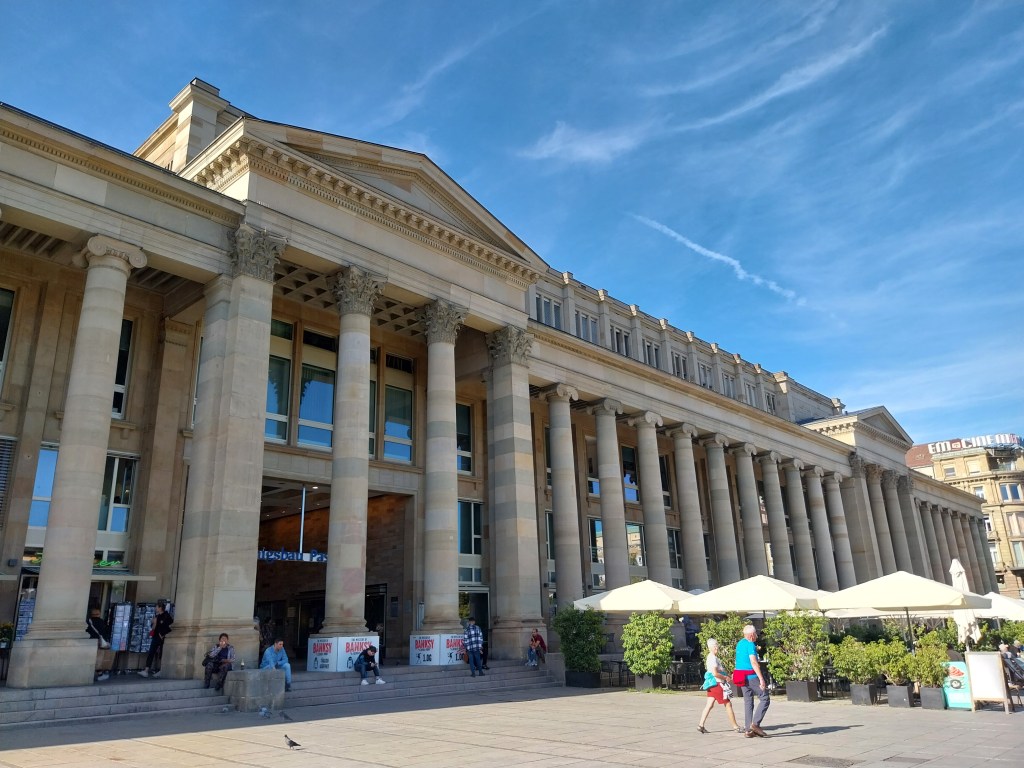

It still seemed quiet for a Sunday until I took a closer look at the bars and restaurants around the Schloss. One of the best known is Carl’s Brauhaus, a traditional German beer hall. The place looked packed, but the thing to remember about a Brauhaus is that the tables are meant for communal dining. I share with another solo diner, a woman who eats and says nothing. When she leaves, she’s replaced by an older couple who are a bit more talkative. There are large groups, couples and individuals, all efficiently served by a team of waiters. It’s not the cheapest place to eat but the food is good.
I’m up relatively early for Monday morning because my research has shown two places I want to visit. First, the Schloss Park which stretches for almost 4km behind the main railway station. In fact, parts of this vast green space are built over tunnels the carry the tracks. At the very top is Wilhelma Zoo. It’s some years since I’ve visited a zoo, and there’s something rather nostalgic in wandering around looking at apes, big cats and meerkats. Even the giraffes are having a great time looking at the weird visitors.

The zoo is also home to an extensive area of botanical gardens, and on a sunny day, it’s a joy to walk around four a couple of hours – the entry fee of €20 seems reasonable enough, though lunch at its cafe cost almost as much. Families with children try and go for the cheapest menu options – but even a bowl of chips costs almost €5 and a bottle of water is €3.40. Like its inhabitants, the zoo has a captive audience – as there are few nearly options for refreshments.
Second on my list is the Mercedes Benz museum. I’m not a huge fan of cars but Stuttgart is where they make these vehicles – and there’s another Porsche museum nearby. However, both are closed on Mondays. Fortunately, I realise this before making a journey across the city, and instead note a big fairground wheel in the distance. A quick tram ride takes me to Cannstatter Volksfest – not, as you may imagine, a celebration of camper vans but a fair dating back a hundred years. On a Monday lunchtime it’s a bit quiet, but the rides are all open for business, as are six vast temporary beer halls. It also turns out that this festival has quite a bit of history.
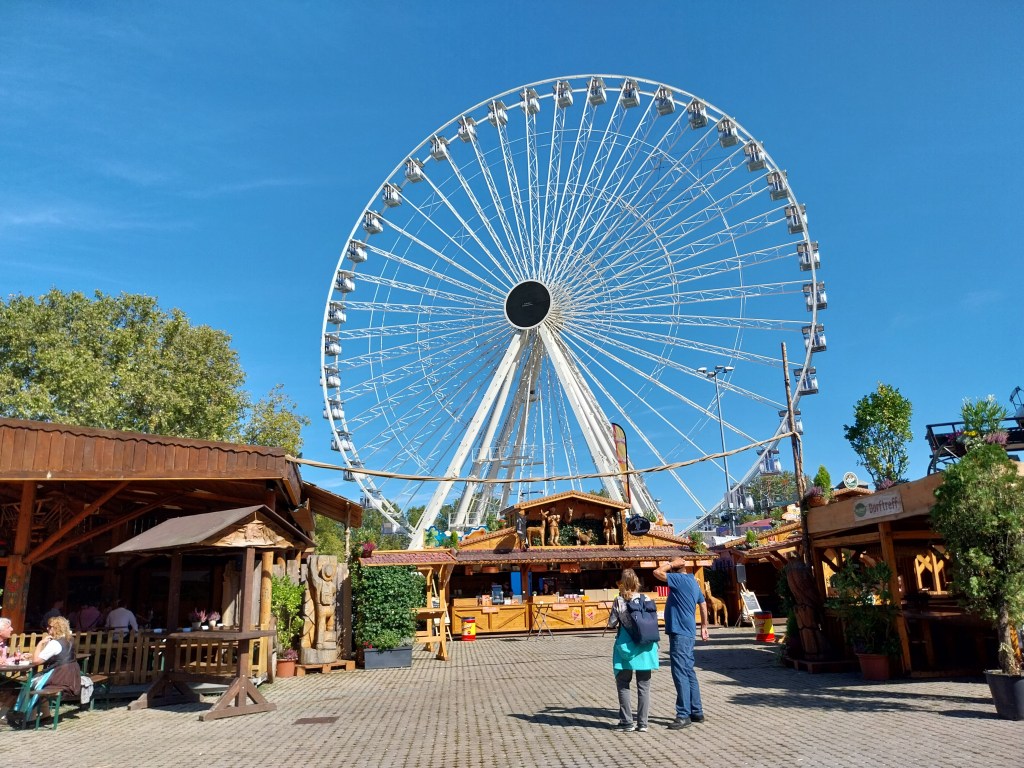
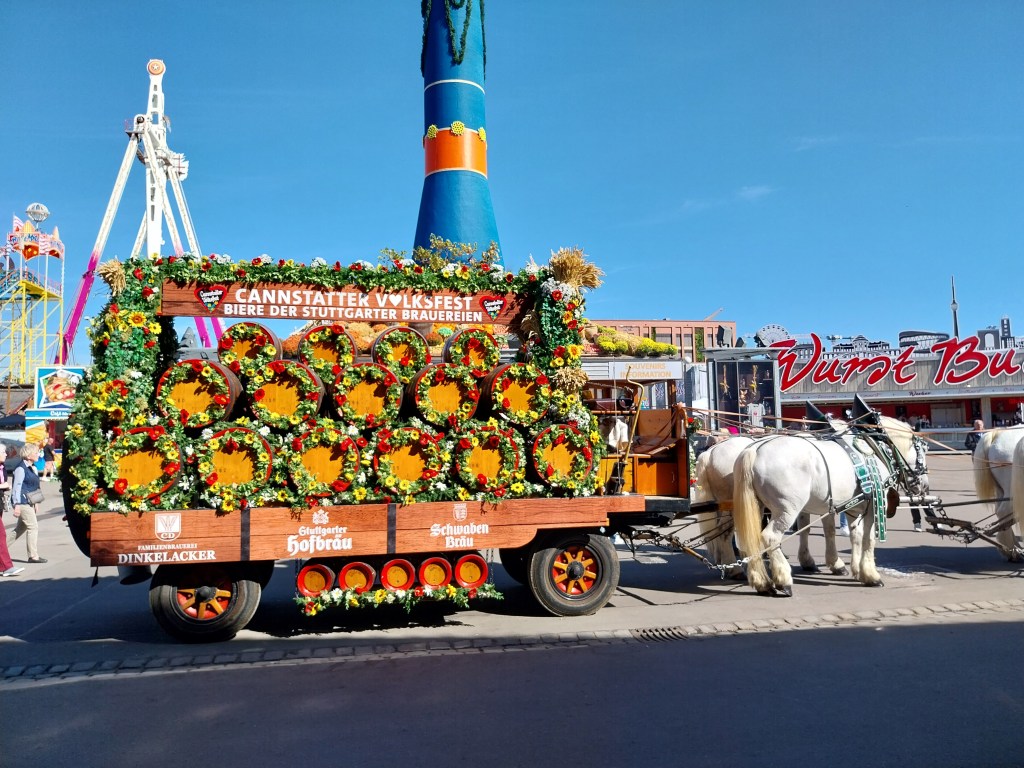
Stuttgart had been badly hit by the Napoleonic wars, so the region’s King at the time hatched a plot to drum up trade. He ordered an agricultural show to show off the very best produce, beer of course being a big part of it. The tradition continues today, with a special beer brewed for the event each year. Like UK beer festivals, the beer halls are run on a token system. And there are plenty of nods to the past, though you’re not supposed to touch them.

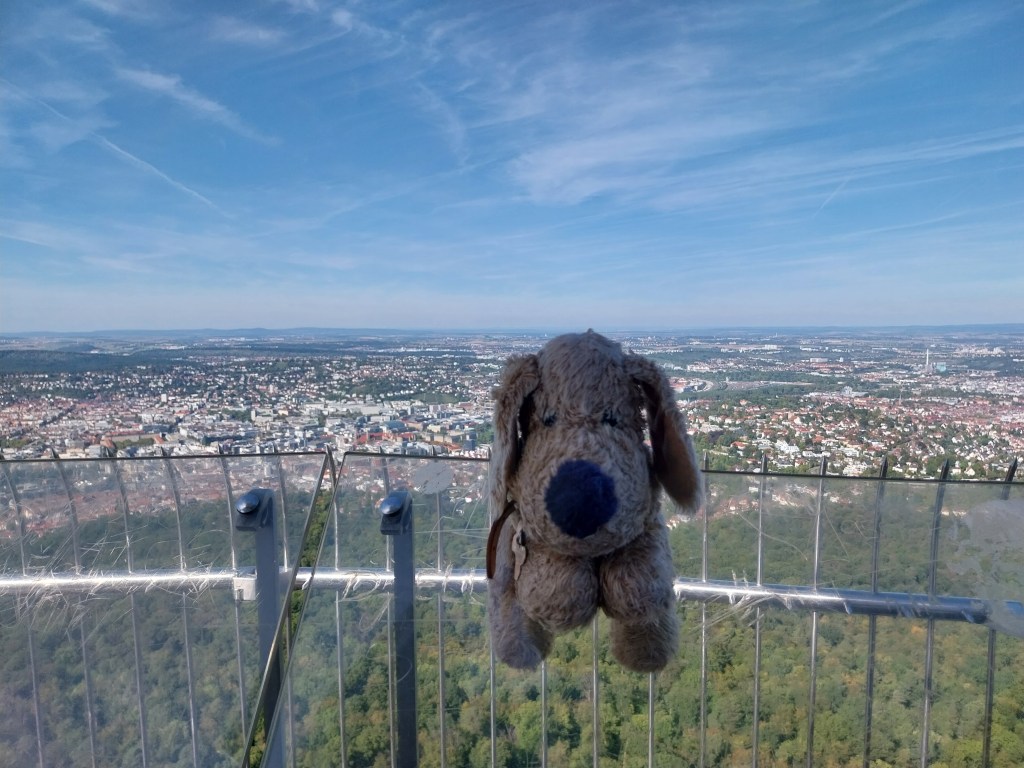
One of the two ferris wheels here may have provided a decent view of the city, but as I look across Stuttgart something catches my eye. They are features of many European cities and I can’t resist going up them. And my luck is in – because the TV Tower is open to the public.

Unlike its counterpart in Berlin, the Fernsehturm here is a couple of kilometres out of the city centre. The U-Bahn 15 train climbs its way up steep roads, the journey itself giving some decent panoramas. Entry to the tower is just over €10, and in less than a minute you’re 150 metres above the ground. And what a view.
Getting here
By train : There’s a daily direct EuroCities train from Villach to Stuttgart which takes about 6.5 hours. If you have a spare day, stop off in either Salzburg or Munich, both on the same route. Your Eurail pass covers the journey, though I would recommend buying a 3 Euro reservation via the OBB website. When searching for connections, select “seat reservation only” as your option.
Tip : to get around Stuttgart easily, consider downloading the VVS Mobile app. This allows you to buy passes for one day or longer on your smartphone, which are valid on all local S-Bahn, U-Bahn and bus services. You’ll need to enter how many zones you’re buying for – the website shows where these are but all of the places mentioned here are in Zone 1, with an adult day ticket costing just under €6 (2023 prices)

Practical stuff
Stay : I stayed at the Hotel Unger, a ten minute walk from Stuttgart main station. Opened in 1958, the place has had an extensive modernisation in recent years and now has comfortable yet compact rooms and a great breakfast buffer.
Eat/drink : Being a large city, you will be spoilt for choice when it comes to restaurants and bars. Platzhirsch, a short walk from the Rathaus (City Hall) offeres traditional German fare. For a beerhall experience, head to Carls Brauhaus in Schlossplatz. It’s a bit touristy and pricey, but worth it for the experience. Palast Der Republik on Friedrichstraße offers cocktails and beers in an outdoor setting.
Getting around : As described above, the VVS map is your mobile transport ticket. This will get you easy access to places like Wilhelma Zoo or the Mercedes Benz Museum. If you’re visiting in late September, the Volksfest festival is held close to the river at Bad Cannstatt.
 TravelCaster
Leave a comment