

Day three, and later on I’ll be covering some 550km to Trieste in Italy’s far north eastern corner. But before that, I have the morning to explore a bit more of Turin. San Marco Piazza looked stunning last night, and it has equal beauty in the daytime. What I didn’t realise was that some of the world’s biggest retail names have their stores under the porticos here. But if there’s one think the Italians do better than shipping, it’s churches – and here, there are two – Santa Christina and Santa Carlo.
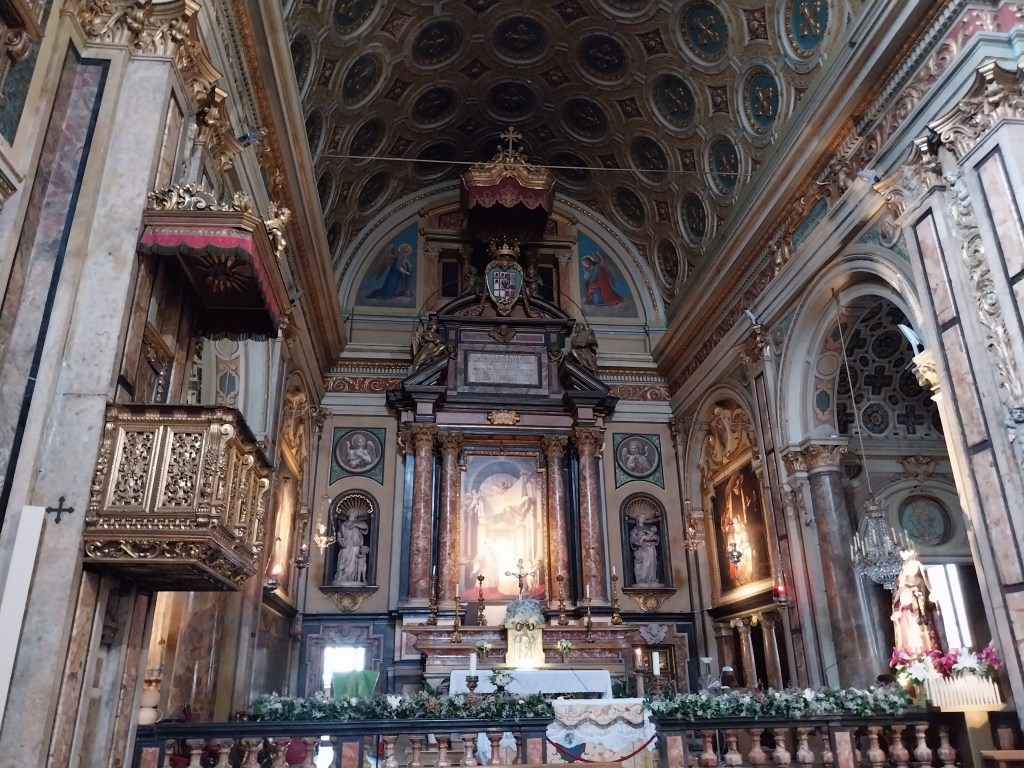
It’s cool and quiet inside Santa Carlo church, whose alter dates back to the mid seventeenth century. The church itself was named after Charles Borromo, a former Archbishop of Milan who led the counter reformation against the Prostestants . What was all that about never mixing religion and politics.
Just across form the square, elegant shopping is back in full swing at the Galeria San Federico. This is typical of Turin’s upscale sopping arcades, having just a handful of very expensive stores. There’s a couple of small cafes, overcharging for brunch, and an art deco cinema, The Lux.

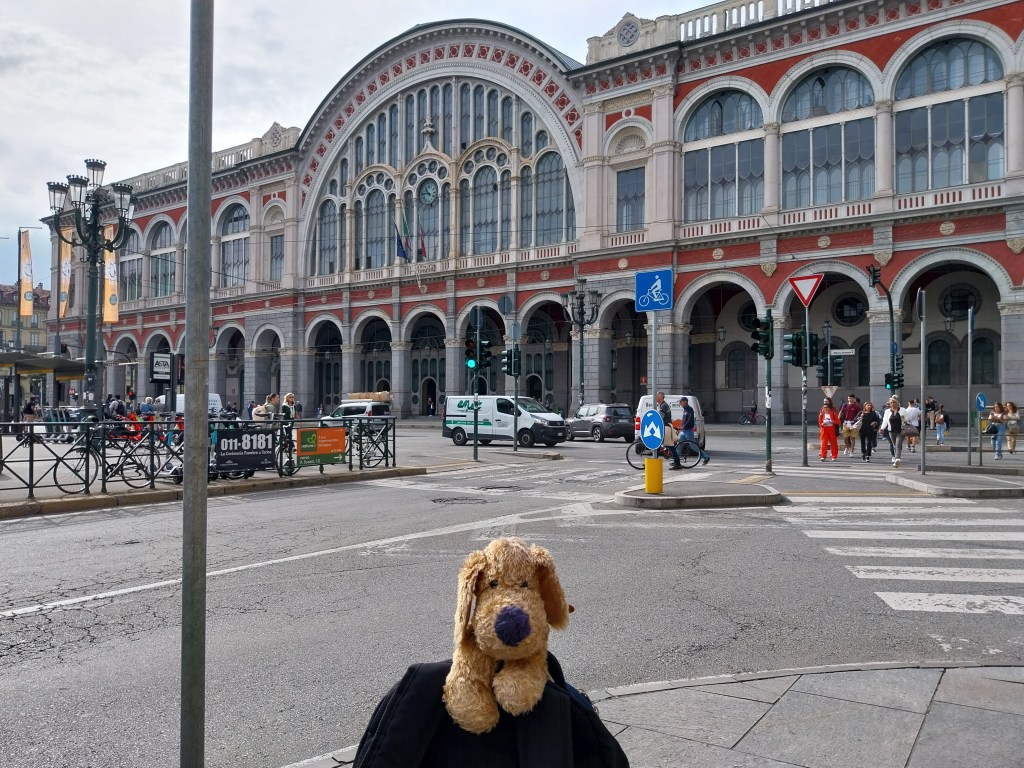
A more economical brunch can be found at any of the eateries in Porta Nuovo station. On the mezzanine, a piano – sadly no chopstick for me, as someone is already playing. Having exited the station by a side entrance yesterday, I hadn’t realised how elegant the main frontage of the building is. Sadly it’s only the outside that has been preserved – the interior a mix of modernisation and 1950s concrete.
The first leg of the journey is a two and a quarter hour hop to Bologna via Milan. The Frecciarossa are the starts of Italy’s railways, providing modern trains and high speed connections through much of the country. My Eurail pass is valid for these services woith another mandatory reservation, costing €15. Looking at online prices for today’s journey and a ticket would have come in at €120, so I feel I’ve bagged a bargain.

First Class is a joy, with plush wide seats and a free snack box containing a scone and a biscuit – but here’s the bonus, soft drinks, tea and coffee are also on offer at your seat. The same can’t be said for my connecting train from Bologna to Trieste. TrenItalia’s Inter City rolling stick has seen better days, although the coaches have been refurbished in recent years – so although the seating is comfortable enough, the ageing outer train creates a noisy rattle throughout.
The final approach to Trieste itself is stunning, as the rain hugs the coast around the Gulf of Trieste before reaching its final terminal. It reminds me of the smaller though equally stunning train journey to St Ives in Cornwall. The sun is setting as the Inter City creaks into Trieste Central.
24 hours in Trieste
For centuries, Trieste has been an important southern port for the whole of Europe. But it didn’t become part of Italy until 1922. It’s biggest influence was arguably the Astro-Hungarian Empire, which ruled in through most of the nineteenth century. The railway station has the feel of faded glory, though it clearly still carries thousands of passengers to this coastal resort.
My hotel – the Albergo – is housed in a beautiful classic building of stone staircase and high ceilings. The reception is run part time, so there’s a strange but efficient process of self check. I’ve emailed a picture of my passport, and in return the hotel has given instructions of how to get in and where to collect my key from a small safety deposit box. An increasing number of accommodations are run this way, a reflection of trying to provide value while reducing the overall staffing numbers.
The sun has set, and Trieste by night is a joy. Many visitors get their bearings by using the Grand Canal – a bit of a misnomer because this small channel is nothing like its cousin in Venice. But it does provide a couple of bridges for mandatory photos.


Yes, even James Joyce gets a look in. Along with a turbulent political history, Trieste has long attracted writers and artists of all kinds. Joyce lived here on and off for around five years and it was here that he started his epic tale Ulysses.
The nearby James Joyce Cafe offers one potential refreshment stop, but here you are spoilt for choice. Even though it’s the middle of the week in September, pavement restaurants are bursting with tourists. And compared to Turin, there is a much wider demographic of visitor here. There are many American accents, a few Brits, but mostly Italians.
This is where they come to get away from the crowds in Venice, and you can hardly blame them. In recent years there have ben protests about over tourism; you may think it odd to complain that too many people are coming to spend money in your city, but when the streets and canals become so full that nobody can move, it’s a problem.
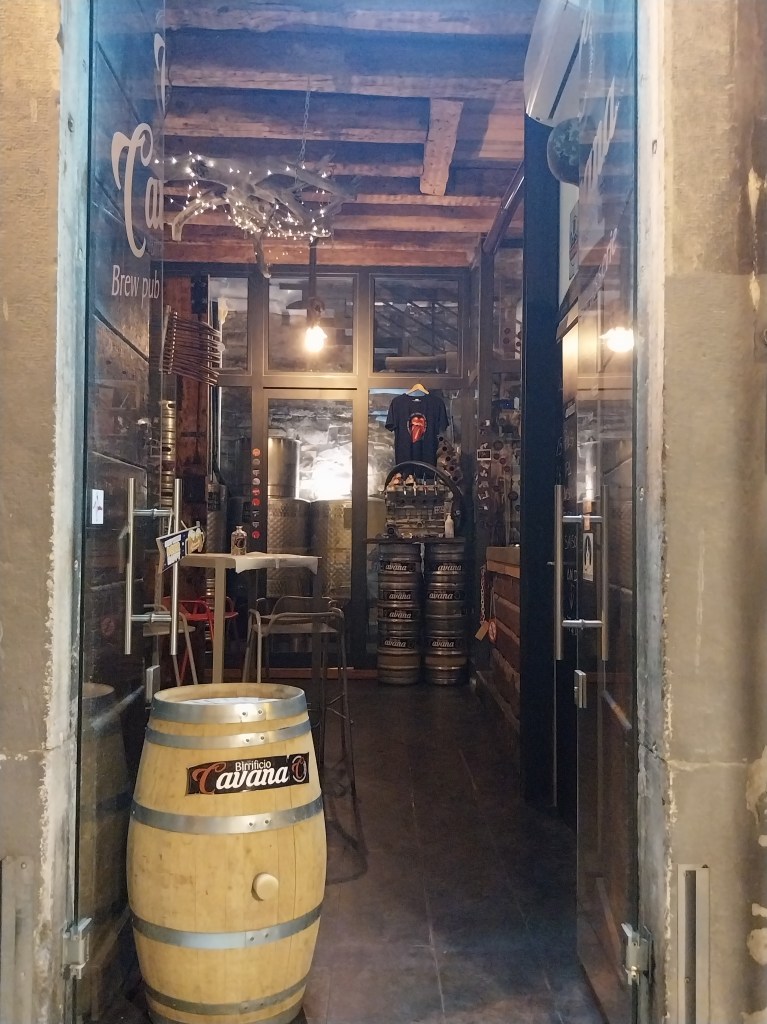
Away from the crowds here, a small back street takes me to a great discovery. Birrifica is a micro pub just a few steps away from one of the main squares. It has around seven of its own brews, and more in bottles. It is, however, tiny, and I’m grateful to have discovered it at a relatively quiet time. It has a laid back, bohemian feel — and just across the road is something equally way out – a 24 hour launderette that also dispenses legal cannabis products. I can’t imagine how that makes your spin cycle look.
As it’s many places in Italy, Trieste is about elegance. It’s strategic place as a major port for Europe made it rich – and much sought after. After the Austro-Hungarians were done, Trieste became part of the still young Italy – though it never quite wanted it. The Second World War saw a Nazi invasion, and then it was annexed by the allies. For a few years it became a free territory before rejoining the rest of Italy.
Trieste’s wealth is signified by its grand buildings, not least the Chamber of Commerce, formerly the Stock Exchange. Immediately opposite is a nod to ongoing political turbulence.


By day, Trieste looks just as busy as at night. Traffic speeds through its one way streets, with strict adherence to the traffic lights, which can make an interesting experience fo pedestrians. A friend tells me Imust see Miramare Castle, some 7km outside the main city. After my usual trick of standing on the wrong side of the road, the number 6 bus pulls up. It’s already a bit of a squeeze on board, but as the bus snakes its way up the coastal road, even more people inexplicably get on, cramming into what little space is left. It makes for a sweaty journey, and means most of the tourists miss they designated stop for the Castle, instead ending up in the small harbour at Grignono. Not literally, you understand.
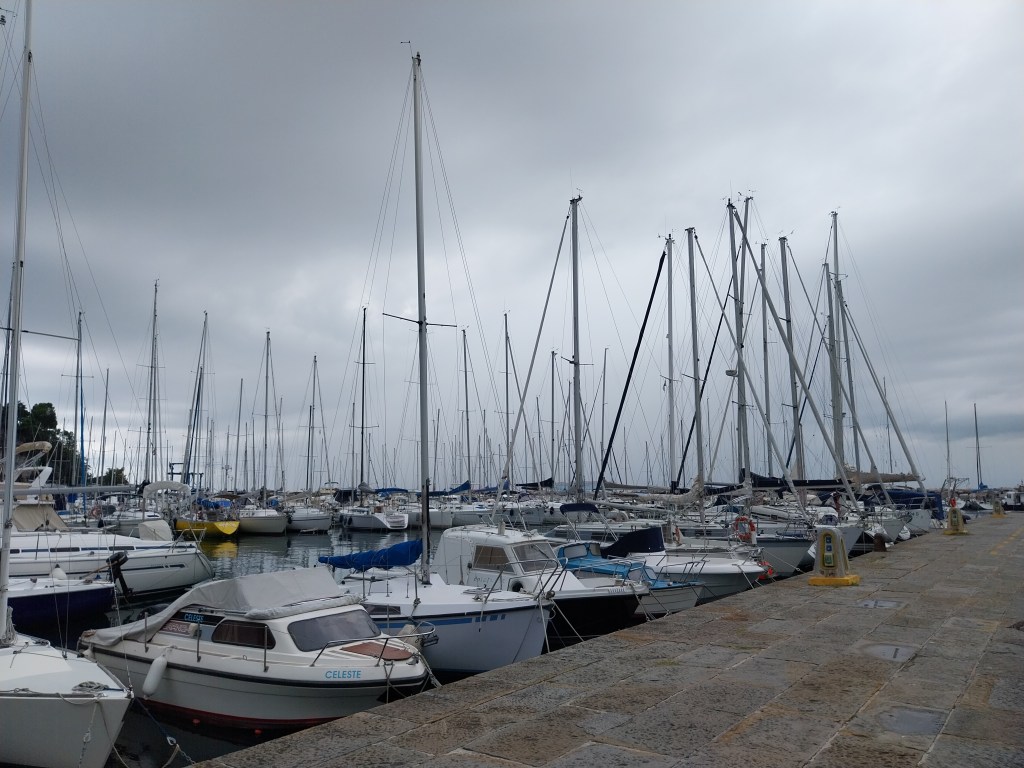
Then again, the threatening clouds signify that rain is on the way. A fifteen minute walk up the hill brings us to the Castle itself – built as a personal home for Ferdinand Maximilian, of the ruling Hapsburg dynasty. Legend has it that he set off on a voyage but was caught in a storm in the Gulf of Trieste, and decided to build his house on the rocky coastal outcrop. And it’s pretty impressive.

The modest €13 entry fee is well worth it, not least to get away from the massive storm which soon engulfs the while area. As the rain lashes down against the windows, you can image Ferdinand plotting his next battle – he was a military man who went on to become the head of the Navy at the time. The inside of the Castle is filled with ornate rooms, and furniture with signs compelling you not to touch or sit on it. Someone has different ideas, as usual.
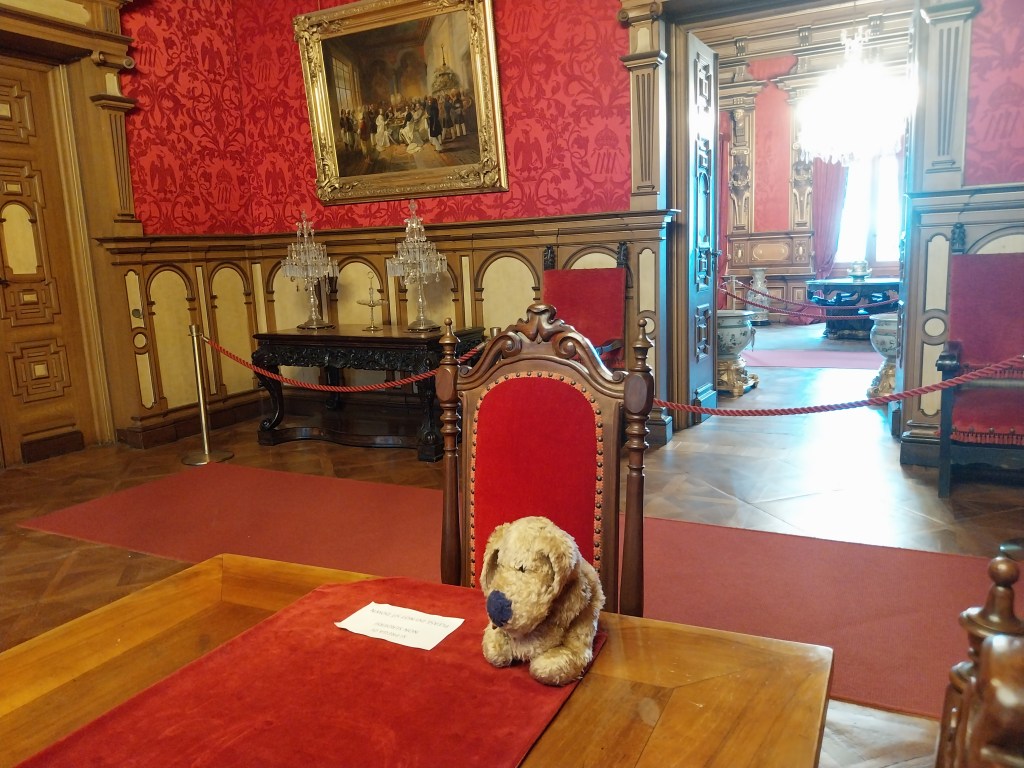
Just as fast as the storm arrives, it subsides, giving me time to walk back to the bus via the exquisite formal gardens. And if you need you roses watering, I know just the person…

It’s almost time to bid farewell to Trieste, which has made an immediate impact on me. As a tourist destination, it’s not on the list of many people outside of Italy. But that’s not to say they don’t come anyway. In the port, a reminder of the fact that commerce can come in many shapes and forms, even if they’re just spending their money here for one day.

The Buffet Bar Borso provides my final meal in Trieste – accompanied by a light white wine spritz. Now don’t get me wrong, I wouldn’t usually condone diluting alcohol with fizzy water, but the spritz is an integral part of every Italian’s aperitivo hour, and it keeps the head clear for the rest of the evening. Which is just as well, as I wouldn’t want to try balancing in the Borso’s toilets.
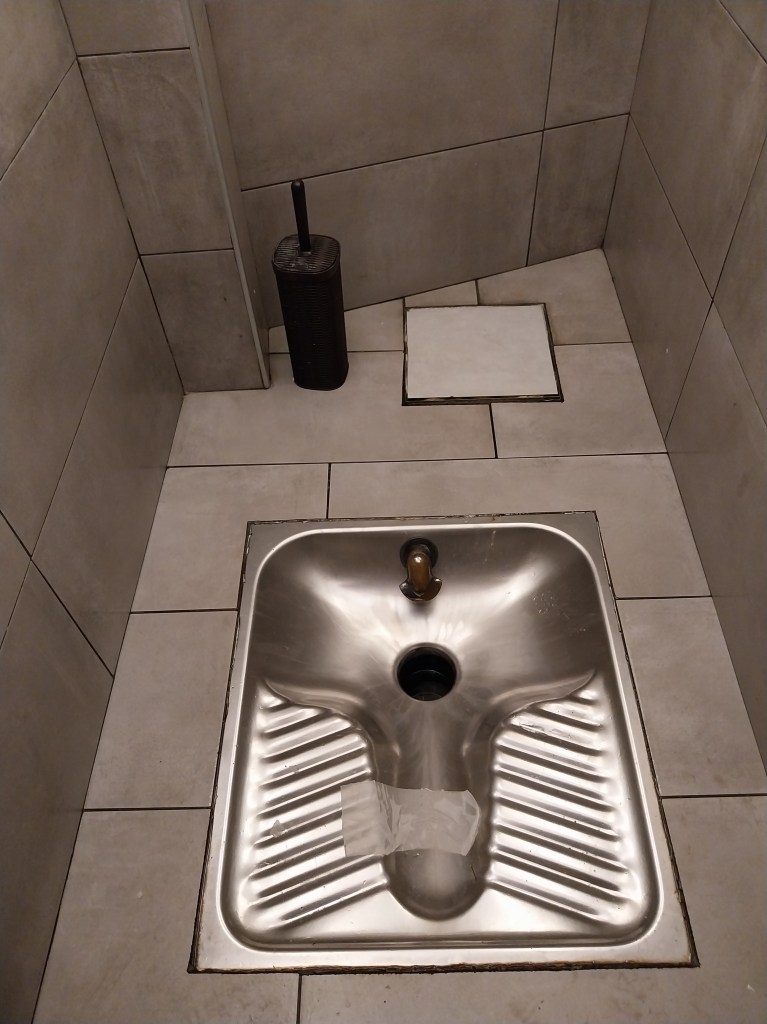
“I am not used to this kind of toilet!” exclaims the woman coming out. Well neither am I, but when in Trieste…
Getting here
By train : Depending on the time of day, you’ll need to change trains at least once en route. My journey took me via Bologna, with a total travel time of 6.5 hours.If you’re traveling on a Eurail ticket, you’ll need reservations for high speed services. These can be booked via Eurail or the TrenItalia website. Beware that Bologna is a huge rail terminal, and it may be a 15 minute walk or more to get to the right platform for connections if coming from Turin.
Tip : Many trains en route to Trieste stop at Venice Mestre station – this is on the mainland. To visit the touristy side of things you’ll neeed to get a connecting service to the Santa Lucia terminal. All of which means it’s probably not an option for a quick stop off.

Practical stuff
Stay : I stayed at the Nuovo Albergo Centro in Trieste – a 10-15 minute walk from Trieste Centrale station. It’s housed in an old building with an ancient but efficient elevator. The rooms are practical and modern – though a mix of private and shared bathrooms in on offer, so be careful which you book.
Eat/Drink : Trieste has no shortages of places for refreshments. If you eat in the bars around the canal you’ll likely pay a premium. Great craft beers can be found at Birrificio located on a side street off Via di Cavana. For dinner Bar Buffet Borsa offers a varied menu of Italian and international dishes. If you’re visiting Miramare Castle you can grab a decent coffee or lunch at Principe de Metternich overlooking Grignano harbour. It’s a little pricey but you’re paying for the view.
Getting around : Trieste has. agood network of local buses for exploring the coastline and the wider area. Day tickets can be bought from any tobacconist shop. Remember to validate your ticket on your first trip.
 TravelCaster
Leave a comment